
When Phones Go Quiet, Curiosity Gets Loud
By Rea Antoniou
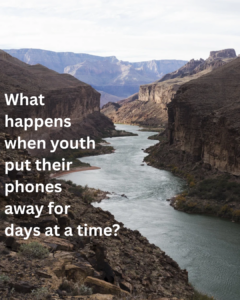
Photo credit: Austin Corbett
That’s a question many adults have probably asked themselves and perhaps something they quietly wish for themselves, too.
Smartphone dependency is so deeply embedded in our lives that research has begun to highlight how smartphones have become part of our extended self. As a researcher in this field, I was thrilled to be connected to Grand Canyon Youth (GCY) to learn more about what youth experience without their phones. During GCY’s phone-free expeditions, youth described how they felt when first separating from their phones. Many youth reported feeling a strange sense that something was missing from their body itself. They also reported a mixed array of emotions: some felt lighter, some nervous, and some kept checking their pockets out of habit.
But over time, something else began to emerge when youth were separated from smartphones: curiosity.
What stood out on the expeditions was not only what youth were removed from, but what they gradually moved toward. As attention shifted away from notifications, scrolling, and the pressure of constant reachability, many youth described becoming more present with one another, with the landscape, and with themselves.
One participant reflected, “We sat for over an hour talking and making art, learning new things together.” Another named their attention shift more directly, toward, “Curiosity in others, ourselves, and our world.” These are not just nice expedition moments. They instead point to a deeper relational process: when youth are no longer pulled into mediated forms of attention, they seem to regain access to forms of engagement that are exploratory and shared. 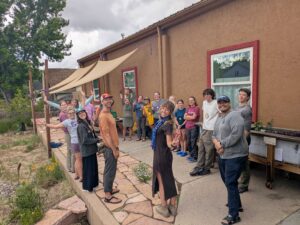
Curiosity seems to be a social veil alternating the way we relate.
It changes how youth encounter each other. Curiosity makes room for longer and deeper conversations, listening to one another, creating art together, asking questions without rushing toward the next distraction. It enables face-to-face interaction in a way that makes connection feel deeper, less fragmented, and more authentic.
Curiosity can spark inwardly as well. What do I feel when there is nothing to check on Instagram? Youth reflections after their expedition suggests that phones often function as emotional buffers, emerging as tools for distraction, escape from boredom, or for avoiding discomfort. Without them, youth may have more opportunity to sit with an experience as it is, without the craving to manage it.
For anyone thinking about youth mental health, there is something powerful here. We often frame youth well-being in terms of reducing harm: less screen time and less anxiety. But these phone-free expeditions point toward a more generative question: what capacities are strengthened when youth experience time, place, and relationship differently?
When the phone falls silent, something might be missing at first.
Yet something is also found.
Curiosity.

Rea Antoniou holds a BSc in Psychology from Aristotle University in Greece and an MSc in Neural and Behavioral Sciences from the University of Tübingen in Germany. For five years, she was a research scholar at the UCSF Memory and Aging Center in San Francisco, where she worked as a mindfulness instructor for dementia caregivers, studying self-compassion as a protective factor in mental health. She is currently pursuing a PhD in Interdisciplinary Health at Northern Arizona University, where she studies the anthropology of loneliness, relational meaning, and the changing contours of intimacy in the age of AI. Beyond academia, she is a creative writer drawn to both poetry and fiction. In her free time, she enjoys trail running and a well-made cup of coffee. In collaboration with Rea during our 2025 season, GCY implemented a new pre- and post-expedition survey to better understand the value of youth experiencing screen-free time on the river.
Are you a professional photographer or videographer interested in helping GCY tell our story? Please email development@gcyouth.org to learn more about how you can volunteer for our nonprofit.
Do you have a submission for The Ripple Effect? Check out our guidelines here.