Courage Below the Rim/Courage Above the Rim:
Rapids, Research, and Carving a Scientist
By Margaret Mattson
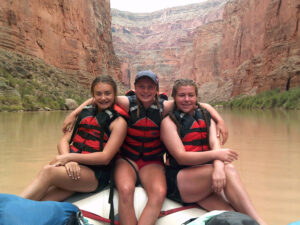
Margaret as a youth
When people ask me how I found myself in a career in biology, I always smile because I get to bring up Grand Canyon Youth. I tell them of hot desert nights on a GCY Partners in Science trip nearly 10 years ago— the feeling of holding a shining, squirming Humpback Chub in my hands for the first time. I reminisce about laying snuggled in a sleeping bag on a riverbank, listening to bat wings overhead, and the stillness of the river in lazy afternoon stretches between rapids. I get to tell them about how Grand Canyon Youth helped foster a love of place in me so profound that it sparked my career exploring how the patterns of evolution, DNA, energy webs, biodiversity, and adaptation ripple through the Grand Canyon ecosystem.
Of course, what I don’t usually mention is that I was much too busy being terrified of whitewater to be thinking about a career in biology at the time. Far from the adrenaline-loving, daring field biologist I am today, in early high school I was all white-knuckle grip, pounding heart, and anxious babbling every time I would hear the roar of a rapid around the next bend. But while I might have been clinging to the boat for dear life through the wave trains and splashes of cold river water, as soon as I saw that my new friends needed me to help bail water out of the boat, I had two hands on that bucket. When it became a matter of caring for my community, I was able to wrestle some of that fear away. This experience of practicing courage, or what I like to think of as “bucket courage”, turned into my first brush with an unexpected principle of being a good scientist in today’s research climate—being braver than you feel about the things that really matter.
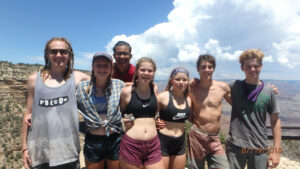
Margaret on a Grand Canyon Youth trip
Nearly a decade since that first trip, I’m still chasing the Canyon’s finned, winged, and furry residents, but now with an arsenal of scientific tools. Today, my work ranges from building genomes, to listening in on the Canyon’s bats with acoustic monitors, to chasing after fish in the middle of the night. My work with the US Geological Survey’s Grand Canyon Monitoring and Research Center (USGS GCMRC) has allowed me to pursue the questions, patterns, rhythms, and quirks of the critters in this place that I hold so dear. Doing field science on a river trip is such a deep and intimate way of being in communion with the Canyon—to learn the language of how its systems work and dance with the rhythms that have shaped life here for millennia. It reminds me of the many ways in which I am the same as the bat, or fish, or midge. Finding those kinships below the rim helps me to access the same ferocity that allowed me to pick up the bucket as a youth, and apply it to defending the creatures that are unable to speak for themselves in our political landscape. While curiosity and wonder at the natural world will always be the foundation of my identity as a scientist, my impulse to protect is what fuels the late nights, long lab days, and difficult field conditions.
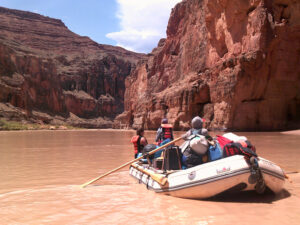
This summer, my love for the river came full circle; I had the privilege of joining a GCY Partners in Science trip as a teaching scientist on a June row trip. It occurred to me: I would be unrecognizable to my high school self. Perched on a pile of dry bags, scribbling in my Rite in the Rain notebook with my right hand, mug of steaming cowboy coffee swishing in my left, the calm and preoccupied researcher that I am today is a far cry from the anxious youth I once was. It was such a joy to watch the spark in so many pairs of eyes on this trip when I got to share my own research, to hear the squeals of joy when youth kissed fleshy Flannelmouth Sucker lips for the first time, and to see the clicking moment when I dug deep into some evolutionary mechanics with the group.

Margaret sharing her work as a scientist with youth participants on a GCY trip this year.
Alongside these moments of muddy joy and wide-eyed learning, there was a tougher reality lurking: science doesn’t exist in a vacuum. One of our projects was removing the long-term bat acoustic monitoring poles due to funding cuts. These monitoring stations were the source of the bat acoustic data that I’ve been working with for the past year, and their removal represents an uncertain future for bat research in Grand Canyon. This visceral contrast between our collective wonder at the 23 bat species that we watched forage over dinner every night, and my deep grief at having to remove our monitoring system for them, reverberated throughout the group. I frequently relied on that “bucket courage” to have very honest, vulnerable conversations about what it is like doing science today. I spent hours on the beaches with youth discussing the reality that discovery and data always live alongside politics, funding decisions, and the need for scientists to advocate for the work and the places they love. I spoke of the importance of channeling the bravery that youth practice on the river in whitewater, sidecanyon scrambles, and challenging sidehikes into doing the hard thing above the rim, whether that be writing a letter to your representatives, showing up to protests, or engaging with programs that facilitate conversations about science and politics.
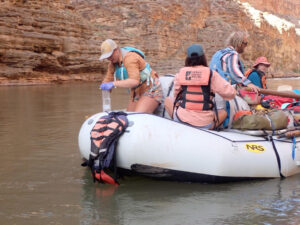
Margaret collecting scientific data on a GCY trip.
So when people ask me how I got into science, I get to tell them about Grand Canyon Youth. I get to tell them about learning to do the hard, scary thing with a bailing bucket in my hands and that it prepared me for a career that requires standing up for the places and creatures that cannot speak for themselves. I get to tell them that I wouldn’t be pursuing a Ph.D. in rapid evolution of Grand Canyon fishes without having practiced the courage to face challenges that intimidate me. And I get to tell them that because of Grand Canyon Youth, I know without a doubt that when push comes to shove, I am a person who picks up the bucket.
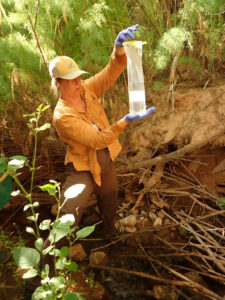
Margaret Mattson is a biologist and Ph.D. student in Integrative Biology at Oregon State University, where she studies conservation genomics and rapid evolution in Grand Canyon fishes. She is passionate about making science accessible through teaching, writing, and storytelling. A Grand Canyon Youth alum, she values fieldwork as much as computation and loves the challenge of doing science in wild places. Outside of research, Margaret can be found out on a trail run, scheming up new ways to drink espresso, or sweet-talking her friends into another backcountry adventure.
Are you a professional photographer or videographer interested in helping GCY tell our story? Please email development@gcyouth.org to learn more about how you can volunteer for our nonprofit.
Do you have a submission for The Ripple Effect? Check out our guidelines here.